


For decades, glazing has been viewed primarily as part of the building envelope — windows, doors, curtain walls, and rooflights designed to keep heat in while letting daylight through.
But in modern architecture, glass is beginning to play a much larger role inside the building as well.
What was once purely decorative is now becoming functional architecture.
Interior glass elements such as balustrades, partitions, sauna panels, and pool enclosures are increasingly being used not just for aesthetics, but also for thermal comfort and energy efficiency.
A key driver behind this shift is the development of heated glass technologies, such as Crystal Units’ NUCLR heated glass, which allows glass to actively contribute to heating a space rather than simply separating it.
The Architectural Shift Toward Interior Glass
Contemporary design increasingly favours:
- open plan spaces
- minimal structural barriers
- clean visual lines
- maximum natural light
Glass naturally supports these design goals.
It allows spaces to feel larger, brighter, and more connected, while still providing separation between areas.
But until recently, interior glass was mostly passive.
It looked impressive, but it didn’t contribute to building performance.
Now that is changing.
Glass That Heats the Space
Heated glass is one of the technologies transforming interior glazing.
NUCLR glass uses a transparent conductive coating applied to the glass surface. When electricity passes through the coating, the glass gently warms and emits infrared radiant heat.
Unlike traditional radiators that heat the air through convection, radiant heat warms:
- people
- furniture
- surfaces
This creates a more even and comfortable thermal environment, often at lower room temperatures.
Research has shown that heated glass can significantly reduce energy consumption compared with traditional convection heating systems.
Heated Glass Radiators
One of the most obvious indoor uses for heated glass is glass radiators.
Instead of wall-mounted metal radiators or bulky heating units, a sleek glass panel can provide the same function.
The benefits are clear:
- no bulky radiators
- more usable wall space
- clean minimalist design
- even radiant heat distribution
Heated glass radiators can be integrated into both modern homes and commercial spaces, blending heating directly into the architecture.
Glass Balustrades That Contribute to Comfort
Balustrades are another area where interior glazing is evolving.
Glass balustrades are already popular because they:
- allow light to flow through spaces
- maintain open sightlines
- create a modern, minimal aesthetic
With heated glass technology, these balustrades can also help stabilise thermal comfort near large glazing areas.
For example, in spaces with large sliding doors or curtain walls, heated glass balustrades can reduce the feeling of cold air near the glass by maintaining a warmer surface temperature.
Heated Glass Partitions
Glass partitions have become a staple in both residential and commercial design.
They divide spaces while preserving light and openness.
However, large glazed partitions can sometimes introduce temperature differences between zones.
Heated glass partitions solve this by acting as both a divider and a heating surface.
This approach is particularly useful in:
- open-plan offices
- restaurants
- residential extensions
- loft conversions
By combining space separation with radiant heating, glass partitions become part of the building’s thermal strategy.
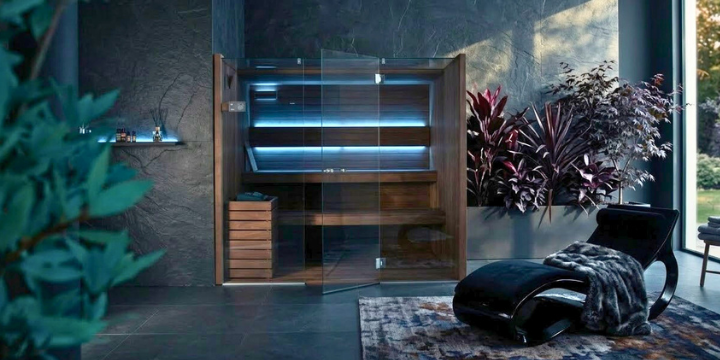
Perfect for Saunas and Wellness Spaces
Wellness design is another area where heated glass is gaining attention.
Saunas, steam rooms, and spa areas often incorporate glass to create a sense of openness and luxury.
However, condensation and temperature differences can be challenging in these environments.
Heated glass helps maintain consistent surface temperatures, which reduces condensation and keeps glass panels clear.
This makes it ideal for:
- luxury saunas
- spa facilities
- wellness centres
Where clarity, comfort, and aesthetics are all important.
Indoor Swimming Pools and High-Humidity Environments
Swimming pool areas are another space where glass performs both visually and thermally.
Large glazed pool enclosures create dramatic architectural spaces, but they also face constant humidity and temperature differences.
Heated glass can help prevent condensation by keeping the glass surface above the dew point.
This improves:
- through the glass
- comfort around the pool area
- maintenance requirements
For architects designing indoor pools or leisure facilities, this technology provides an elegant way to solve a long-standing challenge.
The Future of Interior Glass
As buildings become more energy efficient, the role of individual materials is evolving.
Glass is no longer just about:
- transparency
- daylight
- aesthetics
It is increasingly becoming a functional part of building performance.
Technologies like NUCLR demonstrate how glazing can move beyond the façade and contribute to:
- thermal comfort
- energy efficiency
- architectural flexibility
As designers continue to push toward cleaner interiors and multi-functional materials, interior glass will likely play an even bigger role.
The result is architecture where glass doesn’t just shape spaces — it actively improves how those spaces perform.